On Zooniverse I have been studying the lunar surface in unprecedented detail. I have been locating craters, and other lunar features on our very moon. I have depicted the bouldiness of each crater and whether it is of small medium or large bouldiness. Surveying the whole moon will help scientists in their studies of the moon without them having to do a whole bunch of meticulous work.
Wednesday, May 23, 2012
Zooniverse
On Zooniverse I have been studying the lunar surface in unprecedented detail. I have been locating craters, and other lunar features on our very moon. I have depicted the bouldiness of each crater and whether it is of small medium or large bouldiness. Surveying the whole moon will help scientists in their studies of the moon without them having to do a whole bunch of meticulous work.
Monday, May 21, 2012
Astronomy Cast- Radar
So Radar is one of those technologies that changed
everything
but it also changed astronomy and ground-imaging -- tracking asteroids with
great accuracy, allowing spacecraft to peer through Venus’ thick clouds and
reveal secrets through the Earth’s shifting sands. So radar’s reflected light, flashlight shining on wall is reflected light, and in the other case, you’re looking at a light source. So looking at a radio source with radio astronomy and looking at a star or a galaxy with an optical telescope is looking at a light source as well.
In the late 1800s, in the 1880s and 1890s, we
started to realize that light was more than what we could see with our eyes,
and scientists started realizing, “Hey, I can create radio sources, and then
detect those radio sources. Hey, I can create a constant sound in radio and
then reflect that off of something else and by looking for how the reflected
light comes back, how long it takes to come back, I can realize there’s
something out there.” So just as we were figuring out how to do radio
broadcasts, hand in hand, we were realizing that when radio reflects off of
things, well, that reflection means something there, and that’s kind of cool.
There’s a rather
frustrating story related to Pearl Harbor. America, Great Britain, New
Zealand, Russia – nations all around the world -- were struggling to figure
out how to use radar to detect incoming ships, to detect incoming aircraft, to
basically figure out, “Holy ‘expletive!’ We’re about to get killed!” and be
able to get out aircraft, be able to get people into shelters ahead of time to
help save lives, and we hadn’t gotten to the stage yet of everyone in the
military fully understanding the power of radar to detect things, and when
you don’t have fully trained leaders, bad decisions get made. So at Pearl
Harbor out in Hawaii, there were a couple of privates who decided to get in
a couple extra hours of training on radar, and these were radar stations that
were actually supposed to be shut off, and basically their truck hadn’t come
to take them off to get a meal, so they turned on the equipment and started
practicing, and while they were sitting there practicing, they realized that
there was a larger flock of airplanes than they’d ever seen heading towards
the Hawaiian Islands, and they called this in, but unfortunately, as the
information made its way up the food train, the direction the aircraft were
coming in from got lost and it got misinterpreted as being an expected fleet
of bombers coming in vs. the reality was a huge swarm of Japanese fighter
aircraft.
Exactly, so people start playing with different wavelengths,
different colors, realizing that you could see different things like
precipitation just by changing the frequency of the radar beam. It was a
fairly short leap to realize, Oh, wait! If we use sufficiently long
wavelengths, we can start to reflect light off of, well, planets, and accurately
measure how far away is Mercury, how far away is Venus simply by
sending off a pulse of radar and waiting the minutes and minutes and
minutes and minutes for that light to reflect its way back to Earth.. It allows boats and aircraft to see at night and through thick fog,
Astronomy Cast- Reflection and Refraction
So light can do some pretty strange stuff, like pass through objects and bounce off them. It can be broken up and recombined; in fact, everything we see is just the end
result of reflection and refraction of light, so it’s time to understand how it
all works. So this is the part, this is one of the situations…like, I’ve bent the
mind’s of my children when I was explaining to them. You know, the
concept that when they see something that is like green, they’re seeing the
reflected photons that came from the Sun, and they’re like, “What?!” Right?
Furthermore, we’re seeing the refracted photons that have come from the
Sun passing through our atmosphere, and again, it’s super-confusing, so let’s
start with like the journey of a photon, of a photon that leaves the Sun,
travels to Earth, passes through the atmosphere, maybe goes through a
window or two, bounces off something, maybe bounces off something again
and goes into someone’s eyeball. Well, the first thing to realize is, while you may be following the journey of one ray of light, it may not be the same photon that gets to your
eye that left the Sun originally, or in fact, was originally created because
there’s also a whole lot of absorption and re-emission processes that are
going on. So you start off with something creates a photon, and the original
photon that was created may not be the same photon that reaches your eye,
so you have some sort of an event deep in the core of the Sun gives off
energy, and this bit of energy as it travels through the Sun is going to get
absorbed by an atom, re-emitted in a new direction, absorbed by another
atom, re-emitted in another direction, and this entire process is one of what’s
called “Brownian motion.” It’s the path…the way they always explained it
in physics books, which I think says something about the physics
community is “you know how drunk people walk? That trying to get
somewhere, but they’re sort of going in all directions? That’s the motion of
light as it tries to travel to exit the Sun.” Well, once the light finally breaks
free of the surface of the Sun, then it’s mostly a clean path straight to Earth,
so assuming it doesn’t end up hitting dust, doesn’t end up hitting, well,
Mercury or Venus, or anything else that lies between us and the Sun. So different materials causelight to travel at different speeds, and different wavelengths of light respond in different ways, so suddenly it’s very complicated, but looking in general,
when light hits a material that isn’t a vacuum, it’s going to slow down and
this is where something that I consider a bit of the Universe conducting
Black Magic occurs. There’s this property referred to as Snell’s Law that
basically says if you have light at point A and you’re trying to observe light
at point B, the path the light is going to take between those two points, is the
path that causes it to have the shortest journey time. Now, the thing that
makes this kind of Black Magic is if you can imagine that the light is passing
through a series of different materials -- a pocket of hot gas, a pocket of cold
gas, vacuum from the Sun, or vacuum from outer space, and we’re looking
at sunlight, well, as the light passes through each of the materials, its speed
is going to vary, and just as you can imagine driving through a city, and you
have to make these choices. Now, what’s really cool is you can actually change how the
pencil appears to bend by adding things to the water, by comparing side by
side a pencil or a straw in a glass of alcohol, in a glass of sugar water, in a
glass of regular water – it’s very small differences, but it’s still just neat that
we can actually play with the path of light.
Friday, May 18, 2012
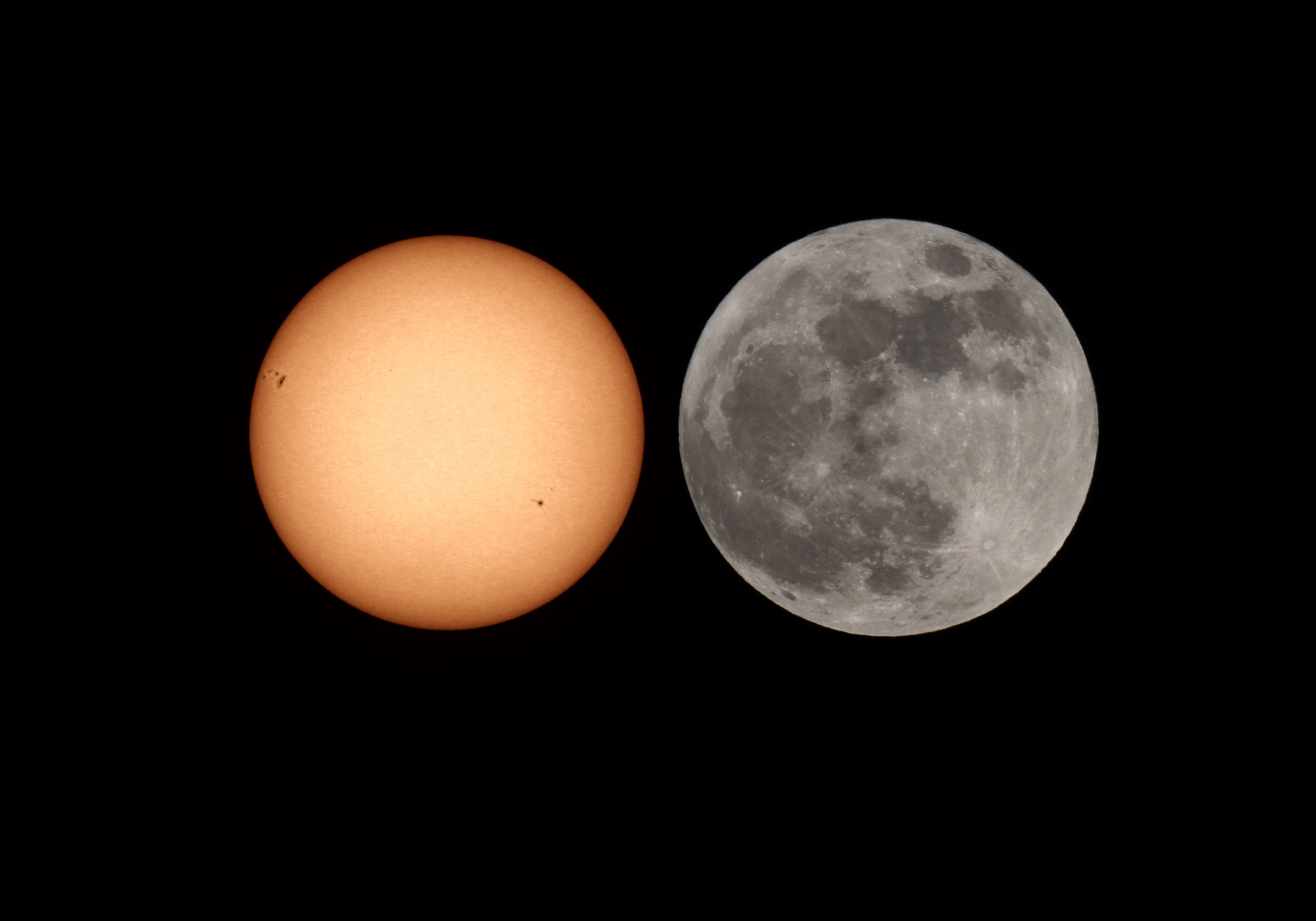
APOD 4.8- Sun vs. The Supermoon
The supermoon appears bigger than the sun on this day. On May 6th, the moon was at perigee, which is the closest point to the Earth in its elliptical orbit. At apagee, the moon will fit just inside the sun and will be the farthest distance away from the Earth and this will occur on May 20th. On this date it will be a new dark moon. On May 20th, the moon will be apparent from almost every point of the Earth and thus easy to compare.
Friday, May 4, 2012
APOD 4.6- Evaporating Blobs of the Carina Nebula
In this picture, you can see unusual blobs found in the Carina Nebula. Many of which that are floating in the upper right could be described as evaporating. Energetic light and winds from nearby stars are breaking apart the dark dust grains that make the iconic forms opaque. The blobs, otherwise known as dark molecular clouds, frequently form in their midst the very stars that later destroy them. The Great Nebula in Carina itself spans about 30 light years and is 7,500 light years away.
Subscribe to:
Comments (Atom)