Friday, April 27, 2012

APOD 4.5-Jupiter and the Moons of Earth

See Explanation.  Clicking on the picture will download
 the highest resolution version available.

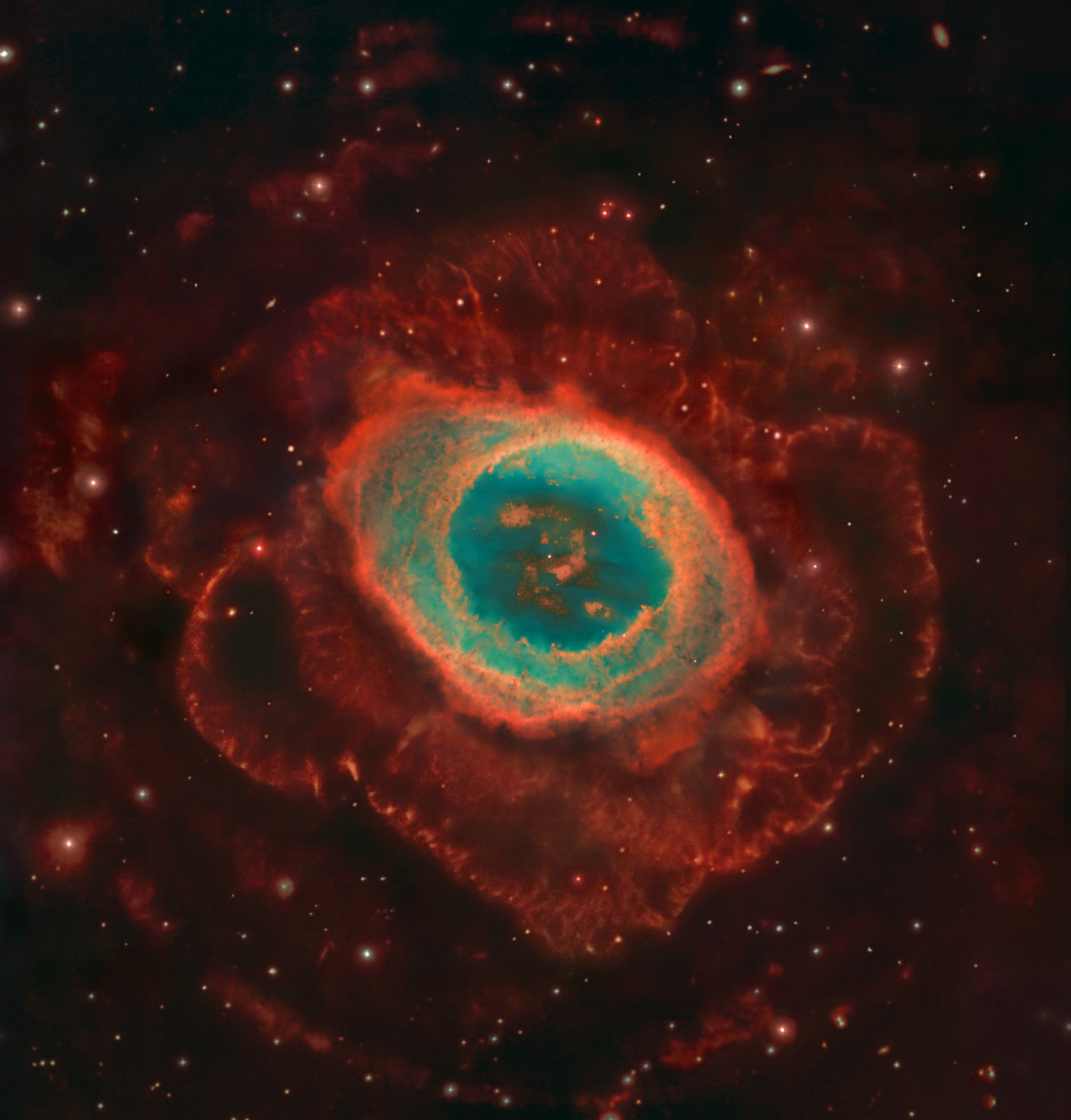
The Earth has many moons, including its largest artificial moon-The International Space Station. In this picture you see the ISS streaking through this lovely skyview with clouds in silhouette against the fading light of a magnificent sunset. Just below and left of the young crescent is Jupiter. Briefly, Jupiter and these moons of Earth formed the remarkably close triple conjunction. Of course the moons of Jupiter are tiny pin pricks when closely examining this photo, which could be a triple conjunction of its own.

Tuesday, April 24, 2012

APOD 4.4- The Ring Nebula

See Explanation.  Clicking on the picture will download
 the highest resolution version available.

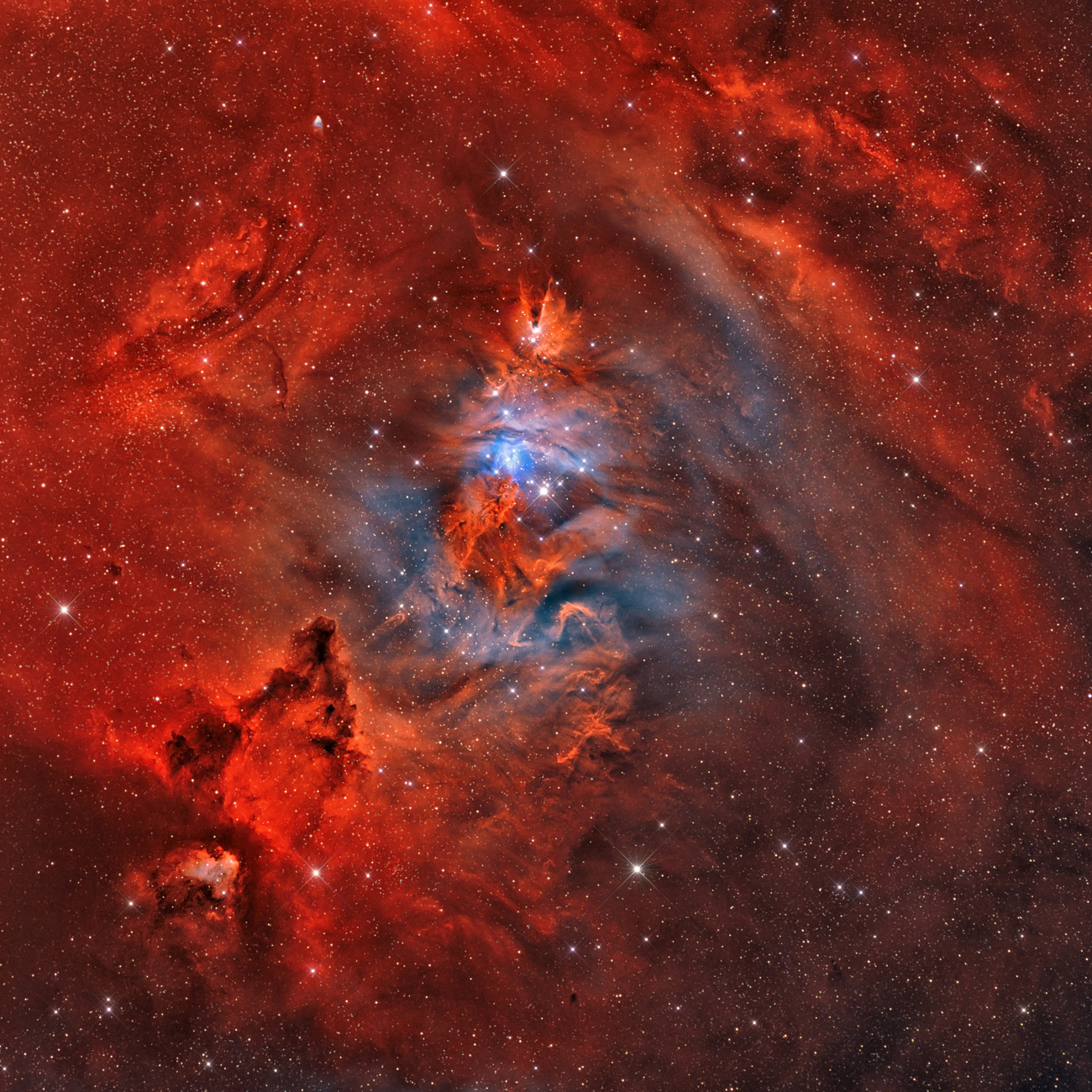
The Ring Nebula (M57) is probably the most famous celestial band, other than the rings of Saturn. Its classic appearance is understood to be due to perspective - our view from planet Earth looks down the center of a roughly barrel-shaped cloud of glowing gas. Of course, in this well-studied example of a planetary nebula, the glowing material does not come from planets. Instead, the gaseous atmosphere represents outer layers expelled from the once sun-like star at the nebula's center. The central ring of the Ring Nebula is about one light-year across and 2,000 light-years away. To accompany tonight's shooting stars it shines in the northen constellation Lyra.

Friday, April 13, 2012

APOD 4.3- A Fox Fur, a Unicorn, and a Christmas Tree

See Explanation.  Clicking on the picture will download 
the highest resolution version available.

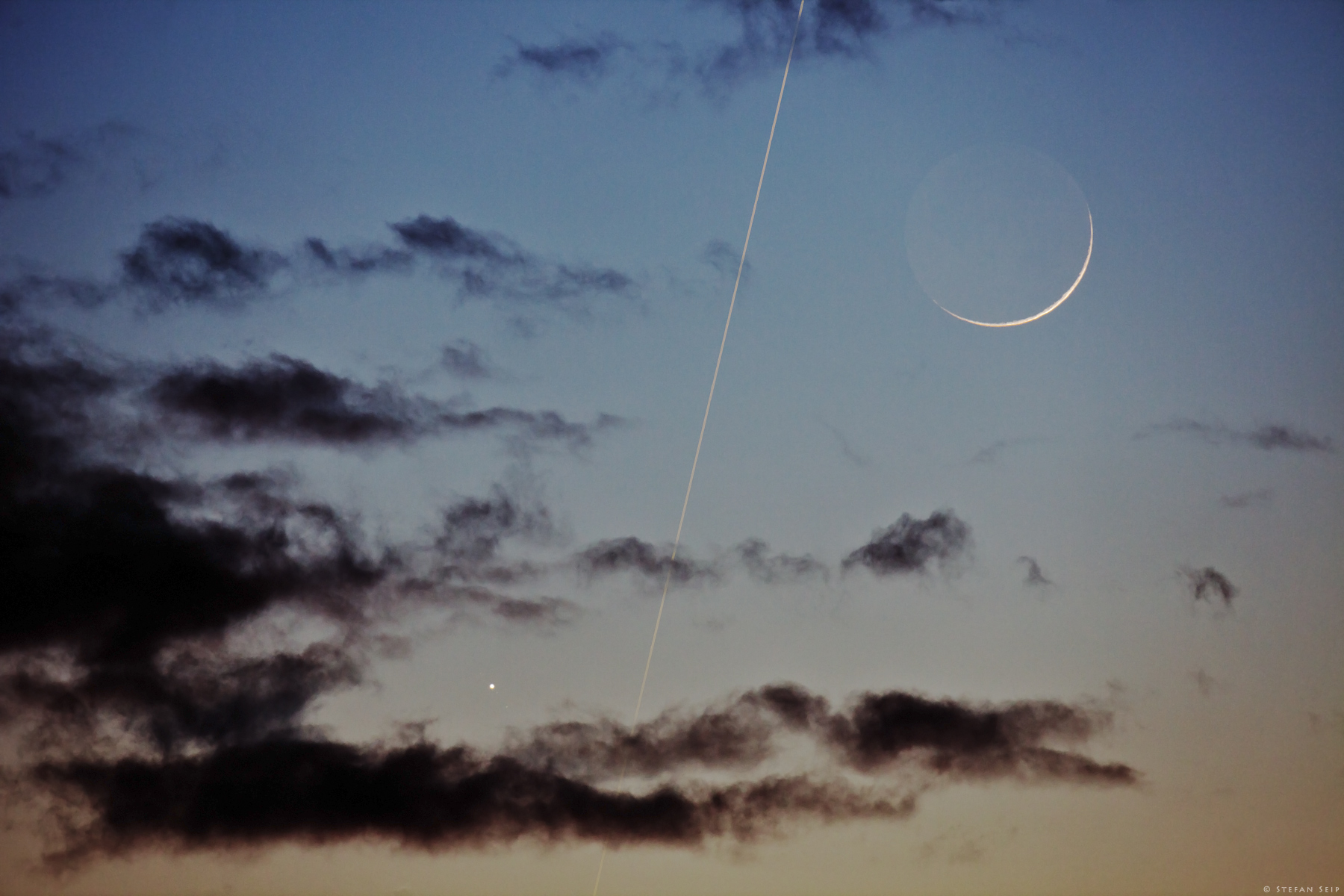
What do the above items have in common? They can all be found in the constellation Monocerous, the Unicorn. The above picture depicts a star forming region named NGC 2264. This complex jumble of dust and new stars is located 2,700 light years away. The dust clouds lay close to the new stars and reflect their light which forms the blue reflection nebulae. This picture spans 40 light years in width and includes the Fox Fur Nebula, a bright variable star and the Cone Nebula.

Wednesday, April 11, 2012

Biography: Gerald Neugebauer


Gerry Neugebauer was known for his work in scientific studies of infared astronomy. Neugebauer was born in Göttingen, Germany and is the son of Otto Neugebauer, an Austrian-American mathematician and historian of science, and Grete Bruck. After moving to the United States at age seven, he received his A.B. in physics from Cornell University in 1954 and his Ph.D. in physics from Caltech in 1960, with a thesis on the photoproduction of negative and positive pions from deuterium.

 Showing his high mental capacity throughout his scholarly years, Neugebauer received his Artium Baccalaureatus degree in physics at Cornell University in 1954 and then receiving his doctorate in the same subject from the California Institute of technology four years later in 1960. Neugebauer played a major role in the design and construction of the W. M. Keck Observatory in Hawaii.

Among Neugebauer's numerous awards are two NASA Exceptional Scientific Achievement Medals (1972, 1984), the 1985 Space Science Award of the American Institute of Aeronautics and Astronautics, the 1985 Richmyer Lecture Award, the 1986 Rumford Prize, the 1996 Henry Norris Russell Lectureship, the 1998 Herschel Medal, and the 2010 Bruce Medal. He was named California Scientist of the Year for 1986 by the California Museum of Science and Industry, and he was elected to the National Academy of the Sciences, the American Philosophical Society, the American Academy of Arts and Sciences and the Royal Astronomical Society.

 Astrophysicist Gerry Neugebauer headed a small group of Caltech scientists who were at the forefront of early infrared studies of the planets. Informally called the "infrarednecks", Neugebauer and his colleagues designed and built new instruments and observational facilities, and discovered hundreds of new infrared sources in the sky. Neugebauer provided the first infrared study of the center of our galaxy, completed a renowned two-micron sky survey with Robert B. Leighton, and oversaw the NASA, British, and Dutch Infrared Astronomy Satellite (IRAS) project, a space-based observatory that surveyed the entire sky at infrared wavelengths.

Neugebauer played a major role in the design and construction of the W. M. Keck Observatory in Hawaii. Among Neugebauer's numerous awards are two NASA Exceptional Scientific Achievement Medals (1972, 1984), the 1985 Space Science Award of the American Institute of Aeronautics and Astronautics, the 1985 Richmyer Lecture Award, the 1986 Rumford Prize, the 1996 Henry Norris Russell Lectureship, the 1998 Herschel Medal, and the 2010 Bruce Medal. Neugebauer continued to develop and expand infrared, sub-millimeter, and millimeter wavelength observational astronomy for decades.  He was named California Scientist of the Year for 1986 by the California Museum of Science and Industry, and he was elected to the National Academy of the Sciences, the American Philosophical Society, the American Academy of Arts and Sciences and the Royal Astronomical Society.

Gerry Neugebauer has commented on the ‘Planet X’ in many notable magazines and newspapers. Planet X is either the 10th planet or the unknown planet. Gerry commented that we do not know what it is, all that we know is that it is a large mass(about the size of Jupiter) that we can see in the distant galaxy.

Right now, Gerry lives in Arizona with his wife Marcia Neugebauer, a geophysicist who has been working at the forefront of solar wind research at the Jet Propulsion Laboratory in the local area.

FUN FACT: Gerry is pronounced ‘Gary’ not ‘Jerry’.
Astronomer Sources: Gerry Neugebauer

http://www.nndb.com/people/061/000171545/

www.badastronomy.com/bad/misc/planetx/science.html

www.universetoday.com/14486/2012-no-planet-x/

Six Not-So-Easy Pieces: Lectures on Symmetry, Relativity and Space-Time by Richard P. Feynman

Sunday, April 8, 2012

Astronomy Cast: Orion


What’s interesting is that we see it as person-y; other cultures see it as three sisters instead of three belt stars, and so they make up all sorts of different stories based around this set of bright stars that hangs out near the celestial equator, and it’s basically a giant box wearing a belt, and so parcel up that giant box however you want it. Now, in western lore it’s typically Orion the Hunter. Here in the northern hemisphere, the two stars you see generally pointing toward zenith are seen as the shoulders — and one of these is the bright-red Betelgeuse — and he’s seen as either holding up a sword or sometimes holding up a shield as he fends off the oncoming Taurus the Bull. So, it’s one of those constellations that people tend to turn all different sorts of things out of it. In fact, you can sometimes even see him in some of the drawings looking away from Taurus the Bull as Taurus comes up behind him. It’s actually kind of as mixed-up as the pictures of the constellation are. It’s not one of the prominent stories in Greek lore, but the basics that most of the stories agree upon is Orion was a hunter, and he had a run-in with Scorpio, the giant scorpion, and after they both died, they got put into the heavens but on opposite sides of the sky, such that Scorpio is up high in the sky six months before Orion is up high in the sky. Rigel, is hundreds of light years away, and the nearest star in the constellation is just 18 light years away. So, we have this vast disparity in the difference between the nearest and the brightest stars, and if you’re able to make a 3-dimensional map of this (and I’ve had various students do that as a class project), it actually shows this fabulous distance distribution even of the belt stars. So this is just a group of stars that appear lined-up, but that’s only because they happen to randomly be collected in 3-dimensional space in the same direction on the sky. And so this is where you end up with interesting things like Betelgeuse appears amazingly bright. It is amazingly bright, in fact it’s about 670 times the size of the Sun, so this is a giant, red, bright, huge star, and it’s about 640 light years away.  So this is a giant star; it has a puffed-out atmosphere. This is one of the stars in the sky that’s most likely to go supernova in our lifetime – that doesn’t mean it will, that doesn’t mean it will even do it in the next 10,000 years, but it’s still sitting there waiting to potentially do it, and if this giant, red star does go supernova, it will actually be visible for almost the entire planet during the daylight.

Astronomy Cast: The Big Dipper


So when you’re looking at the Big Dipper, you have the bowl, and then moving away from the bowl, you have the three stars that make up the handle, and the middle star of those three if you have really keen eyesight, you’ll see there’s a little buddy hanging out next to the really bright star, and that little buddy is Alcor, and this was an eye test to get into the elite military for a while, so while it’s hard to track down exactly where the constellation came from, I find it fascinating that this may have been one of the very first eye tests around. Now when you say double star, that’s just two stars that appear close together. These aren’t stars that are orbiting one another or anything like that, but it does qualify as a widely-spaced double star. Now, the thing is these stars, if you keep looking at them better, they then split themselves apart again, making this a quadruple system because each of them are independently binary systems.  So, while they are both double systems, you can’t actually split both of them. It’s one of those unfortunate things where Alcor – it really… it’s a spectroscopic binary, so if you look at it with a big telescope attached to a spectrograph, watch it over time, you see the lines dancing apart from the two different stars, but with your standard backyard system, you’re not going to split it into two different stars. Mizar, on the other hand, all you really need is clear skies and a really good eyepiece on even a small backyard telescope, so I’d say pull out your handy dandy friendly 70 mm refractor and a 4 mm eyepiece, if your sky supports it, and you should be able to split those.  So that is one of the brightest stars, but we’re used to thinking of constellations as politely being: alpha’s the brightest, beta’s the next, gamma’s the next, but with this particular constellation, they actually labeled things right to left and sort of didn’t worry about what was the brightest or not, so if you want to keep track of which is which, you start at the upper right-hand star and go around in a clockwise direction and you get alpha, beta, gamma, delta as you go around. So yeah there’s a bunch of stars, they’re not individually as spectacular as the stars in Orion. In Orion you have Betelgeuse and Rigel and it’s a party, but in The Big Dipper, Ursa Major, really it’s about the objects that are clustered around the constellation itself . Many of the most famous Messier objects — ones that you all recognize looking at pictures from Hubble — are all located in this one constellation.

Thursday, April 5, 2012

APOD 4.2- Paris by Night

See Explanation.  Clicking on the picture will download
 the highest resolution version available.

In this picture, you will notice Paris and all the famous landmarks that are a part of this famous city. You will spot tourist attractions from the Eiffel Tower to the Arc de Triomphe. What this picture is focusing on is no tourist destination but the celestial triple conjunction of Venus, Jupiter and the Moon which I personally saw from my house near the same time that night. This spectacular beauty was seen by the Western Hemisphere and appreciated world wide for its rariety and lovely appearance. Jupiter is near the moon and Venus is the brightest object in the night sky, looming above both the moon and Jupiter.